I owe engineers an apology.
No, it’s not because my team broke something or filed an incomplete ticket. This isn’t that kind of apology. It’s more of an acknowledgment that after years of watching cross-functional systems up close, it becomes painfully obvious where most “bugs” originate. And it’s almost never inside engineering.
The truth is simpler and more uncomfortable.
Quality usually fails before the code exists.
It fails in the planning stage, in the missed conversations, in the vague expectations, in the “we’ll clarify later” moments, and in the places where people rush decisions because deadlines feel more important than definitions. By the time something reaches an engineer, the root cause is often buried under layers of assumptions.
Engineers just happen to be the ones forced to unearth it.
Where the real cracks start forming
If you sit at the intersection of marketing, product, and engineering long enough, you start seeing predictable patterns. They’re not dramatic, but they’re consistent. Something gets scoped quickly because someone is excited. Requirements are drafted but never fully agreed on. Two teams walk away with different interpretations. A conversation in Slack overrides the last version of the spec, but only half the participants remember. The work continues anyway because the sprint moves on.
None of this screams “bug” at the moment. But it plants the seeds.
When the feature finally hits QA or reaches users through a flow nobody fully validated, someone spots something that “looks wrong.” And instead of tracing the logic, the simplest story becomes: “It must be engineering.”
But if you follow the trail backward, the issue almost always starts upstream.
Quality decays through tiny fractures long before anyone opens an IDE.
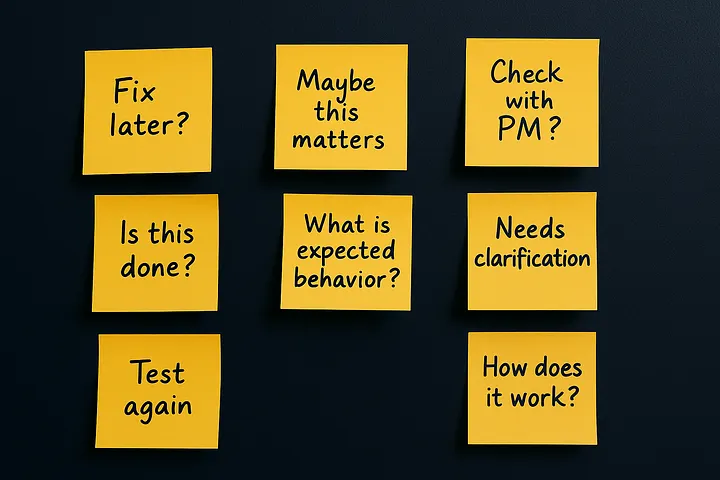
Why everything becomes a “bug” by the time engineers see it
People don’t label things as bugs because they understand the system. They label them as bugs because that’s the easiest bucket for unexplainable behavior.
When there’s no shared definition of expected behavior, anything unexpected feels like a defect. When acceptance criteria are vague or nonexistent, QA has to reverse-engineer intent. When a requirement was only verbally discussed, the documentation never matches the implementation. When marketing or product teams pivot quickly, the UI and backend logic quietly diverge.
None of these scenarios involve engineering mistakes. They involve structural ambiguity.
And ambiguity is the true bug factory.
To an engineer or SDET, this all translates to hours of root cause analysis on issues that were never technical problems to begin with. Debugging becomes archaeology. Testability becomes compromised. Reproduction steps turn into guesswork. And the investigation leads back to a truth nobody wants to admit:
The defect wasn’t introduced during development. It was introduced during misalignment.
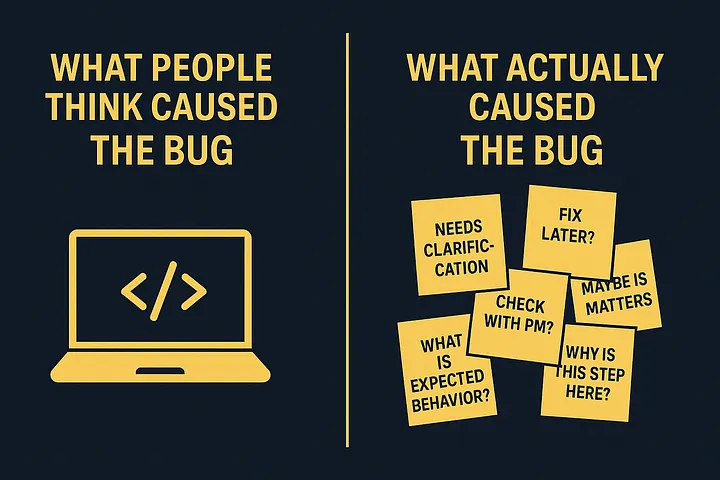
The invisible roles engineers end up playing
When cross-functional dysfunction hits, engineers turn into much more than engineers.
They become:
- detectives reconstructing fragmented requirements
- diplomats navigating conflicting interpretations
- translators between business intent and technical reality
- historians piecing together the timeline of decisions
- firefighters putting out problems they didn’t ignite
A lot of engineers don’t resent the code. They resent the ambiguity.
The hard part isn’t building something. It’s building something that aligns with the shifting, undocumented, sometimes contradictory expectations of the people around them.
This is why the blame funnel always slopes toward engineering. They’re the last team in the pipeline with enough structure to expose the gaps that everyone else blurred on the way down.
Process-skipping is the real villain
There’s always someone who tries to “go fast” by bypassing process. They skip intake, skip clarifying questions, skip QA, skip documentation, skip the conversation about edge cases because “we don’t have time.”
But skipping clarity doesn’t make work faster. It just shifts the burden to engineering and QA.
A rushed requirement becomes a test case that doesn’t make sense. A missing acceptance criterion becomes a bug report. A quick decision becomes a long debugging thread. And a vague expectation becomes a defect that magically appears during user acceptance testing.
Going fast without clarity is still a mess, even if it looks polished.
SDETs and QA professionals know this intimately. They aren’t testing code. They’re testing alignment. They’re testing the story behind the feature, the decisions that shaped it, and the places where those decisions conflict.
When alignment is missing, everything becomes brittle.
So here’s the apology
This apology isn’t for breaking something. It’s for everything the system puts on engineers because nobody else wants to slow down long enough to prevent problems.
I’m sorry engineers get dragged into issues caused by upstream decisions. I’m sorry they have to interpret requirements that weren’t written. I’m sorry they get asked to validate behavior that was never agreed upon. I’m sorry they become the safety net for everyone else’s shortcuts.
Engineers don’t get enough credit for the clarity they bring to unclear situations. For the restraint they show when a requirement is missing. For the calm they maintain when timelines are unrealistic. For the fact that their work is often the only thing standing between a company and a very expensive customer-facing mess.
Quality fails in the spaces where people stop communicating. Engineers simply happen to stand at the end of that space.
If you’re preparing for SDET or QA interviews, this is the real lesson
Top-tier interviewers aren’t trying to trick candidates. They’re trying to figure out who can navigate the same ambiguity and cross-functional friction I just described.
They want people who:
- ask clarifying questions without being prompted
- challenge assumptions instead of inheriting them
- think about risk and edge cases early
- communicate expectations clearly
- design tests that uncover systemic weaknesses
- prevent small alignment issues from becoming production incidents
Real testing isn’t “does it work.” Real testing is “does it work the way everyone thinks it should.”
The best SDETs are the ones who stop quality failures at the source. Not during coding. Not during regression testing. But in the conversations that happen before any of that begins.
If you want to build that level of thinking, that’s exactly what The SDET Playbook was created for. It’s a clear, structured way to understand testing beyond “finding bugs” and start seeing the entire system — the people, the process, the risks, the gaps.
Engineers and QA deserve fewer apologies and more alignment.Fewer surprises and more clarity.Fewer “quick looks” and more solid groundwork.
And they deserve teams who understand that quality starts long before the first line of code.