We spend a lot of time in the engineering world discussing how AI can generate boilerplate code, write test scripts, or summarize documentation. But we are arguably missing its highest-leverage use case: acting as a strategic sounding board for complex, systemic bottlenecks.
A colleague recently shared a prompt template with me, and it has completely shifted how I approach deeply entrenched architectural and quality challenges. I don’t know who the original author is (if it’s you, please take credit in the comments!), but it is a masterclass in prompt engineering.
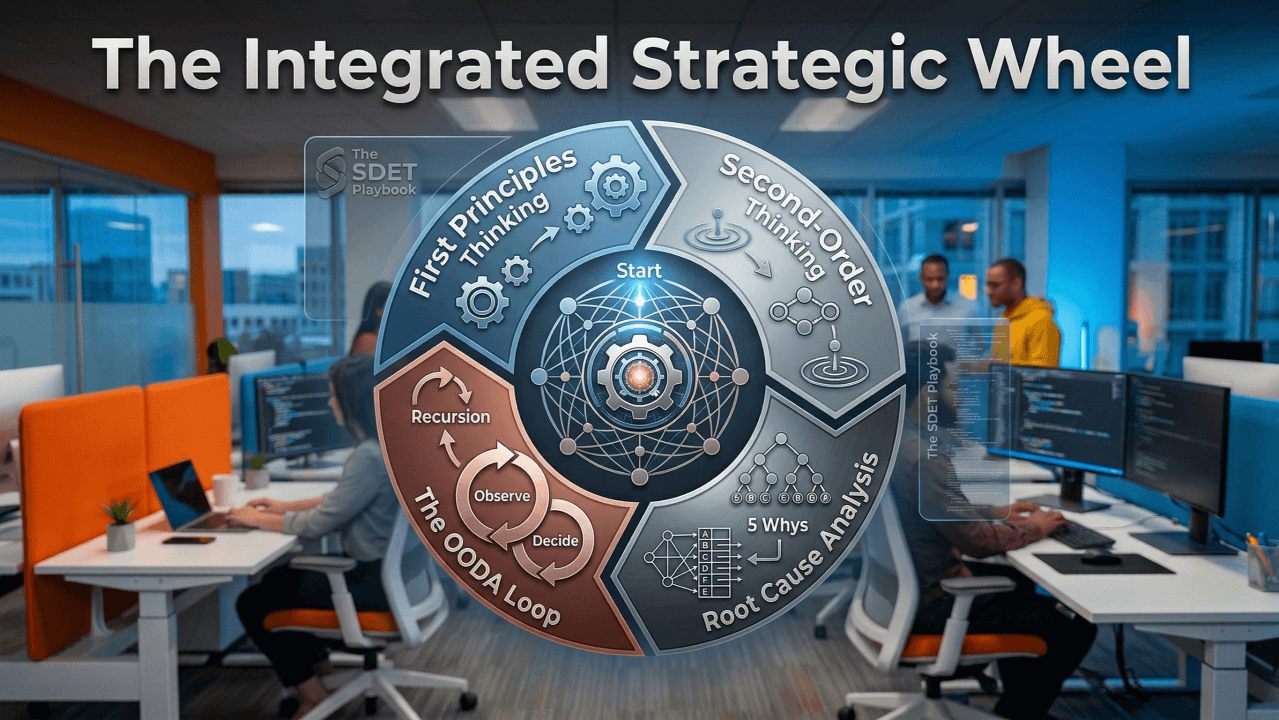
It’s called the "Wheel of Problem-Solving."
Instead of asking the LLM for a quick answer, this prompt forces the AI to deconstruct your problem through four distinct, rigorous mental models before it is allowed to offer a solution.
Here is the exact prompt. Feel free to copy and paste it the next time you are staring down a complex system failure, a CI/CD pipeline overhaul, or a strategic team challenge.
AI Role: You are a world-class strategic consultant and business coach. Your goal is to help me deconstruct a complex problem using a multi-faceted approach called the "Wheel of Problem-Solving." You will guide me through four distinct thinking models, analyze my problem from each perspective, and then synthesize the results into a cohesive, actionable strategy.

---

My Core Problem: [YOUR TOUGHEST PROBLEM HERE. Be specific.]

---

Now, let's begin the analysis. Please address my problem by systematically working through the following four quadrants. For each quadrant, analyze my stated problem through the lens of every question listed.

### Quadrant 1: First Principles Thinking

(Strip everything back and start from zero.)

1.  What do we know for sure is true about this problem? (List only objective facts.)
2.  What are the underlying assumptions I might be making? (Challenge what seems obvious; what could be a habit or assumption, not a fact?)
3.  If we were to build a solution from scratch, with no legacy constraints, what would it look like?
4.  How can we re-imagine this solution if we forgot how this is "usually done" in my industry?
5.  What is the absolute simplest, most direct version of solving this?

---

### Quadrant 2: Second-Order Thinking

(Zoom out and see the bigger picture and potential consequences.)

1.  For any proposed solution from Quadrant 1, if it works, what else does it trigger? (What are the immediate, secondary effects?)
2.  What does the situation and the proposed solution look like in 6 months? 2 years? 5 years?
3.  Are we at risk of solving a short-term pain but creating a larger long-term problem?
4.  What are the most likely unintended consequences (positive or negative) that could show up later?
5.  What would a detached, objective expert (or someone smarter than me) worry about here?

---

### Quadrant 3: Root Cause Analysis

(Fix the entire system, not just the surface-level symptom.)

1.  Describe precisely what goes wrong when this problem manifests. (What are the specific symptoms and triggers?)
2.  What is the first domino that falls? (What's the initial event or breakdown that leads to the problem?)
3.  Apply the "5 Whys" technique: Ask "Why?" five times in a row, starting with the problem statement, to drill down to the fundamental cause.
4.  Where have we tried to solve this in the past and failed or made it worse? (What can we learn from those attempts?)
5.  What systemic factors (e.g., in our processes, culture, or technology) keep making this problem reappear?

---

### Quadrant 4: The OODA Loop (Observe, Orient, Decide, Act)

(Bias towards immediate, intelligent action.)

1.  Observe: What is the raw data? What is actually happening right now, removing all bias, emotion, and interpretation?
2.  Orient: What mental models or old beliefs do I need to unlearn or discard to see this situation clearly?
3.  Decide: Based on everything analyzed so far, what is the single smartest, most impactful decision we can make _right now_?
4.  Act (Hypothetically): What is the smallest, fastest, lowest-risk test we can run immediately to validate our decision?
5.  Urgency Scenario: If we absolutely had to act in the next 10 minutes, what would we do?

---

### Final Synthesis & Strategic Recommendation

After analyzing my problem through all four quadrants, please provide a final summary.

1.  **Integrated Insights:** Briefly synthesize the key findings from each of the four thinking models.
2.  **Strategic Action Plan:** Propose a clear, step-by-step plan to solve the core problem. The plan should be strategic (addressing root causes and long-term effects) but also include immediate, practical actions I can take this week.
Why This Works for Engineering Leaders
When you are designing high-scale quality ecosystems or managing massive test data reporting, the surface-level symptom is rarely the actual problem.
By forcing the AI through First Principles and the OODA Loop, you prevent it from giving you generic "best practices." Instead, you get a tailored, multi-dimensional teardown of your specific architectural reality.
How are you currently using AI for high-level problem solving? I'd love to hear what prompts or frameworks are working for you.
