If you’ve ever walked out of an interview thinking “that didn’t reflect what I actually do,” you’re not imagining it.The QA and SDET interview process really is broken, not because interviewers are malicious, but because the system hasn’t caught up with what modern quality engineering actually is.
The Disconnect
Quality professionals are asked to:
- Solve algorithm puzzles like pure software engineers,
- Explain test strategies in 5 minutes that take months to build in real life, and
- Recite buzzwords like “shift left” without ever being asked how they actually shift in practice.
We’re measuring the wrong signals, and it’s causing talented engineers to fail tests that have nothing to do with their day-to-day excellence.
The irony?The people who thrive in QA are the ones who find weaknesses in systems, yet they’re being filtered out by a weak system.
What a Good Interview Should Measure
Instead of checking whether someone remembers every sorting algorithm, strong QA interviews should evaluate:
- Systems Thinking: Can you reason about architecture, dependencies, and trade-offs?
- Risk Awareness: Can you prioritize testing where it actually matters?
- Tool Competence: Do you know how to build automation that scales beyond a demo?
- Communication Under Ambiguity: Can you articulate thought process when the requirements aren’t crystal clear?
Those are the real signals of a senior SDET, not whether you can code a palindrome in 90 seconds.
The Fix: Strategy Over Trivia
Behind The SDET Playbook is Hien Nguyen, a QA and automation engineer who’s spent more than a decade testing both products and people’s assumptions about how interviews work.
When he went through his own loops at top tech companies, he realized the problem wasn’t that candidates weren’t smart enough, it was that the interview system wasn’t built for how QA engineers actually think.
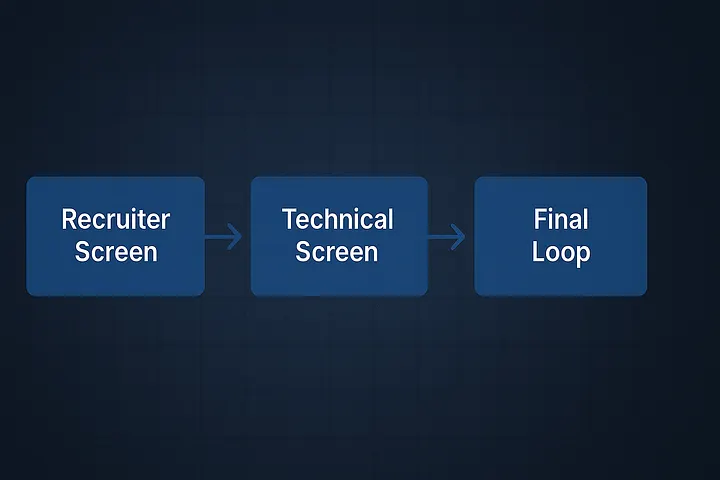
That realization shaped what later became The SDET Playbook, a three-stage framework that helps engineers navigate interviews with clarity and confidence:
- The Recruiter Screen: Position yourself clearly and concisely.
- The Technical Screen: Demonstrate logic and approach, not panic typing.
- The Final Loop: Show senior-level thinking through frameworks like TESTED and STAR.
Each stage demands a different mindset, and when you understand that structure, the process stops feeling random.
A Smarter Way to Prepare
Here’s a simple truth:You don’t need to study harder. You need to study smarter.
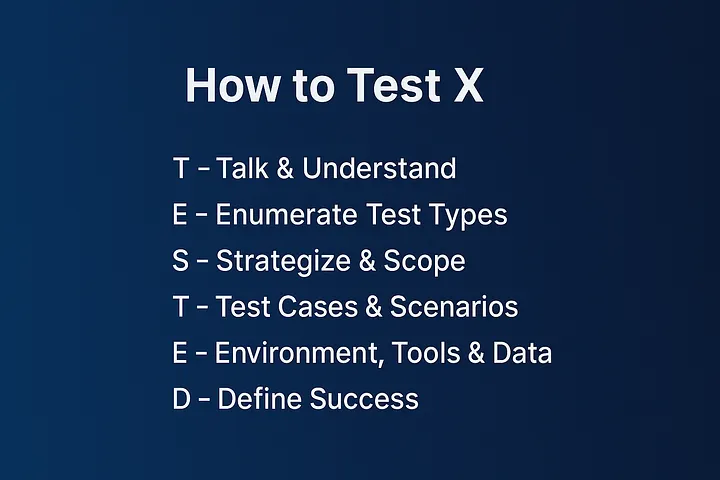
The TESTED Framework is one of the methods we teach for answering “How would you test X?” — a notoriously open-ended interview question.
Here’s how that framework breaks down:
- T — Talk and Understand
- E — Enumerate Test Types and Strategies
- S — Strategize and Scope (Prioritize)
- T — Test Cases and Scenarios
- E — Environment, Tools, and Automation Strategy
- D — Define Success
This structure helps you stay focused and organized, so your answer shows depth and intent instead of a scattered list of test cases.
The Bigger Picture
The industry doesn’t need more trick questions.It needs better ways to evaluate real-world problem-solving, curiosity, and craft.
That’s the goal of The SDET Playbook. To help engineers stop winging it and start winning it.
If you’ve ever felt like you know you’re capable but can’t seem to pass the interview gauntlet, you’re exactly who this community was built for.
🚀 Join the Movement
- LinkedIn Group: The SDET Playbook Network — connect with QA professionals sharing interview prep tips.
- Subreddit: r/TheSDETPlaybook — community breakdowns, mock questions, and job insights.
Let’s fix the QA interview, one candidate, one company, one framework at a time.